Article: Tiffany's Favrile Art Glass
Tiffany's Favrile Art Glass
"Favrile" is a term Louis Comfort Tiffany trademarked in 1894, derived from an old word meaning "handmade" — a guarantee to customers and collectors that the glass was of the finest quality and made entirely by hand. He applied it to all of the glass produced under his direction at the Corona glasshouse in Queens, New York. What sets Favrile glass apart from virtually everything else being made at the time is that the color, texture, and iridescence exist within the body of the glass itself. Nothing is painted on, enameled, or applied to the surface after the piece leaves the furnace. The color is the glass.
The Corona Glasshouse
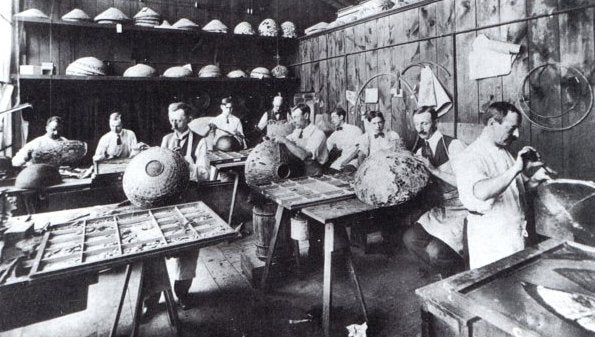
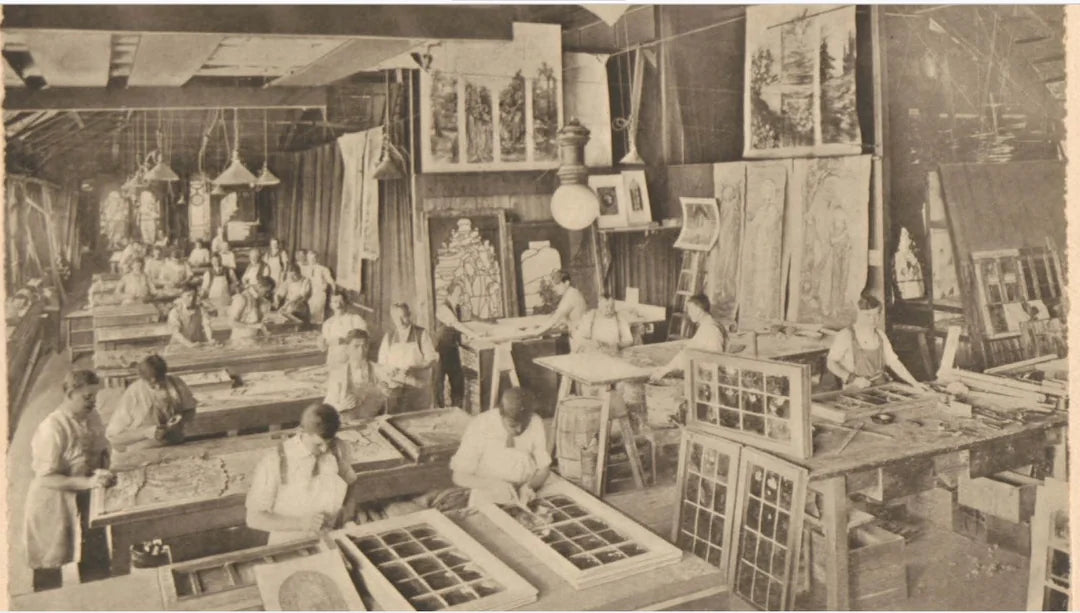
It was while preparing the chapel for the 1893 Columbian Exposition in Chicago that Tiffany felt the need to have his own blown glass. At that time he had fifteen years of experience making tiles, windows, and mosaics, but it was a fortunate meeting with Arthur J. Nash that made possible the realization of his desire to produce blown glass. Nash had just arrived from England, where he had been a manager for one of the Thomas Webb glasshouses in Stourbridge. The two men decided to work together and formed a corporation — the Stourbridge Glass Company, incorporated in April 1893 that was later to become Tiffany Furnaces. The first shop was set up in a building in Corona, Long Island that had formerly held a laundry.
After a devastating fire destroyed the original wooden building on October 28, 1893 killing one workman — Tiffany rebuilt in less than four months. By early 1894, the furnace hall was operational with two separate teams working side by side: one dedicated to sheet glass production for windows and lamp shades, and the other to mouth-blown decorative art glass.
Louis C. Tiffany was always the designer. Arthur J. Nash was the plant manager. Nash encouraged the workmen to learn the full range of English and Venetian types, but Tiffany often criticized them with his repeated comment: "Too much Stourbridge." He wanted, above all else, free creativity and new organic qualities emerging from the inherent nature of the glass itself.
The Iridescence
Tiffany was fascinated by ancient Roman and Cypriot glass that had developed a natural metallic sheen through centuries of burial and chemical decomposition. He sought to achieve that iridescent finish deliberately — by reversing the aging process, checking the natural decay of glass in such a way as to arrive at the effects without disintegration.
Tiffany employed a series of chemists to work out the technical problems and perfect his glass formulas. According to accounts from workers at the factory, they first achieved the iridescent "colors" in 1895, a little more than a year after operations at Corona began, but it took another two years before the results were considered good enough for full production.
The iridescent surface was achieved by exposing hot glass to metallic fumes while it was still in a molten or semi-molten state. The process was a combination of chemistry and physics — mixing metallic oxides into the glass produced the color and luster, while carefully controlled heating and oxidizing created the changeable, multi-colored surface.
Because the chemical reactions were never perfectly repeatable, no two pieces of Favrile glass are exactly alike. Tiffany considered this a feature. He was far more interested in the aesthetic qualities of the glass itself than in the final form it took, and many of his early pieces were considered finished just as they came out of the lehr — the annealing oven — with no post-production treatment at all.
Types of Blown Favrile Glass
Gold Iridescent is the most common type of Favrile blown glass. It is mono-color gold in intent, but multi-colored because of the nature of glass, its treatment, and means of production. Hold one under a light and rotate it, change the intensity of light, and you have a kaleidoscope of shifting hues — golds, greens, purples, pinks. Some have what is called an "onion skin" finish, a fine crackled texture in the iridescent surface layer.
Blue Iridescent is considerably rarer than the gold. The primary color is a deep blue, with the same shifting iridescent qualities found in the gold pieces.
Opalescent Glass is made by covering reactive glass — that is, glass which is sensitive to heat so that it changes color when heated — with colored glass, so that when the two are reheated, the end result is a glass with delicate pastel colors. Usually the inner layer is produced with a clear design in patterns called "diamond," "quilted," or "branches." Tiffany's opalescent blown glass has a particularly interesting "light feeling" in contrast to the solidity of the gold and blue iridescent pieces. Some opalescent pieces display what is known as a "Reactive Star" pattern visible in the glass.
Reactive Glass is an unusual and technically complex type of blown Favrile glass characterized by subtly shifting color tones depending on whether light is transmitted through the piece or reflected off its surface. A reactive vase may appear one color in daylight and shift to an entirely different hue when backlit or when the light source changes. This effect was achieved through the introduction of various metallic elements during the glassblowing process — an often volatile process that took great skill to achieve. Reactive glass was developed in the 1890s at the Corona glasshouse and is frequently found in combination with the paperweight technique. These pieces are among the most visually striking Favrile glass ever produced, as the color seems alive and constantly in motion.
Paperweight Glass uses a technique similar to that which is traditional in the making of glass paperweights — the millefiori technique. Decorative elements — flowers, leaves, vines — are worked in hot glass and then encased entirely within thick layers of additional transparent glass, creating internal three-dimensional compositions visible from the outside. These are among the most technically demanding pieces the glasshouse ever produced.
Aquamarine Glass is a variation of the paperweight technique. As gaffer Jimmy Stewart described the process: "When you would look at it, its color was inside; its outside was a flint color, transparent, you could look through it. We decorated on the outside, and we would go back in the furnace again and put another layer of clear glass over that." The internal decorations. fish, seaweed, underwater plant life — appear suspended within the body of the vase. Stewart called it "underwater glass." The gaffer whose specialty was
aquamarine glass was Arthur E. Saunders, who came to Corona in 1900 and left in 1918. The sheer weight of the thick glass layers made these pieces incredibly difficult to manipulate on a blowpipe.
Cypriote Glass deliberately mimics the rough, pitted surface of ancient glass that has been buried for centuries. Tiffany was intrigued by the glass of ancient Greece and Rome, and he sought to achieve the iridescent finish produced by the aging process of glass which was buried or exposed to the elements. From this came two of his most prized glasses: Cypriote and Lava.
Lava Glass has a rough, volcanic texture — heavy, dark, and irregular. Along with Cypriote, Agate, and Aquamarine glass, Lava pieces are among the rarest types produced at Corona and are almost impossible to locate except when they appear at important auctions.
Floriform Vases
The flower form was introduced by Tom Manderson, the first master blower — or gaffer — at Tiffany's. Manderson came from Philadelphia, where he had worked for Gillinder Glass. It was Manderson who introduced the flower form, the pyroform, and the jack-in-the-pulpit vases that remained popular shapes even after he himself left Corona.
Many of Tiffany's most recognizable blown glass forms were adopted from nature as part of the Art Nouveau movement of his day. These delicate vessels typically feature elongated stems rising from a bulbous or disc-shaped base, with ruffled, flared rims that evoke the open petals of a flower. They required considerable skill from the glassblowers, as the thin walls and dramatic proportions left very little margin for error.
Marks and Identification
Authentic blown Favrile glass is typically signed with a hand-engraved inscription on the underside. The most common marks include "L.C.T." scratched into the pontil, "LCT Favrile," or the full inscription "Louis C. Tiffany Favrile." Most pieces also carry an identifying number, often preceded or followed by a letter that corresponds to the year of production.
The letter dating system works as follows: pieces with no letter prefix generally predate 1894. From 1894 to 1900, two letter prefixes were used per year (A and B for 1894, C and D for 1895, and so on through L in 1900). From 1901 to 1905, the system continued with M through Y as prefixes. Beginning in 1906, a single letter was used as a suffix rather than a prefix, continuing through 1928.
Many pieces also carried paper labels. The most common authentic label features a green background with gold embossed lettering displaying an LCT monogram surrounded by the words "Favrile Glass" and "Registered Trademark." Earlier pieces may carry a label for the Tiffany Glass & Decorating Company.
Special designations include "x" for experimental pieces and "o" for special orders.
Production Timeline
Free-blown Favrile glass was produced at Corona for more than thirty-five years, from 1892 until 1928. The production fell into three periods: the early period, 1892 to 1900, when experimentation and variety of shapes and colors dominated; the peak period, between 1900 and 1918, when the greatest quantities of items were produced; and the late, or Nash, period, from 1918 to 1928, when pastel colors were featured.
At the peak of its production, Tiffany Furnaces turned out almost 30,000 items of blown glass each year. The variety was staggering — every possible size and shape of vase or bowl was turned out at one time or another. There were so many variations they almost defy classification.
After Tiffany's retirement, Nash and his sons briefly continued glass production under the name A. Douglas Nash Corporation, but this venture was short-lived. Tiffany glass cannot be reproduced. All the men who made it have died, and the conditions in which it was produced cannot be re-created. Tiffany vases will always remain the finest examples of the golden era of American art glass.
Selling Your Tiffany Studios Glass
If you own an authentic piece of Tiffany Favrile Glass, and are considering selling, we invite you to contact us directly. We are always actively acquiring high quality period decorative arts for our private collectors and would be happy to discuss the potential purchase of your piece.