Duffner & Kimberly
A Guide to Duffner & Kimberly Lamps
The Duffner & Kimberly Company was a premier manufacturer of leaded glass lighting in the early twentieth century. Founded in December 1905 and bankrupt by April 1911, the firm produced high-quality lamps for barely five years. Today, authentic Duffner & Kimberly pieces are among the most sought-after objects in the antique lighting market, prized by collectors for their exceptional metalwork, distinctive period designs, and extreme rarity.
The History of Duffner & Kimberly
The firm was officially incorporated in New York in December 1905, backed by an enormous initial capital investment of $350,000. The founders brought significant industry experience to the venture. Oliver S. Kimberly was a talented stained glass artist who began his career designing windows for Tiffany in the early 1890s. He worked in the window department before transferring briefly to the lamp department, then left in late 1899 to form his own stained glass company, Calvert & Kimberly, with fellow Tiffany artist Thomas Calvert. That partnership won a Gold Medal and Grand Prize at the 1904 St. Louis World's Fair before dissolving in late 1905, at which point Kimberly entered the new partnership with Frank Duffner.
His partner, Frank J. Duffner, brought over twenty years of experience in the lighting industry. Duffner had worked for Bradley & Hubbard, the Manhattan Brass Company, co-founded the Pittsburgh Brass Company in 1886, served as head of the Lamp Department for the Phoenix Glass Company from 1889 to 1901, and managed the New York office of Plume & Atwood before forming the new venture. He served as President of the Duffner & Kimberly Company, responsible for sales, marketing, and business strategy.
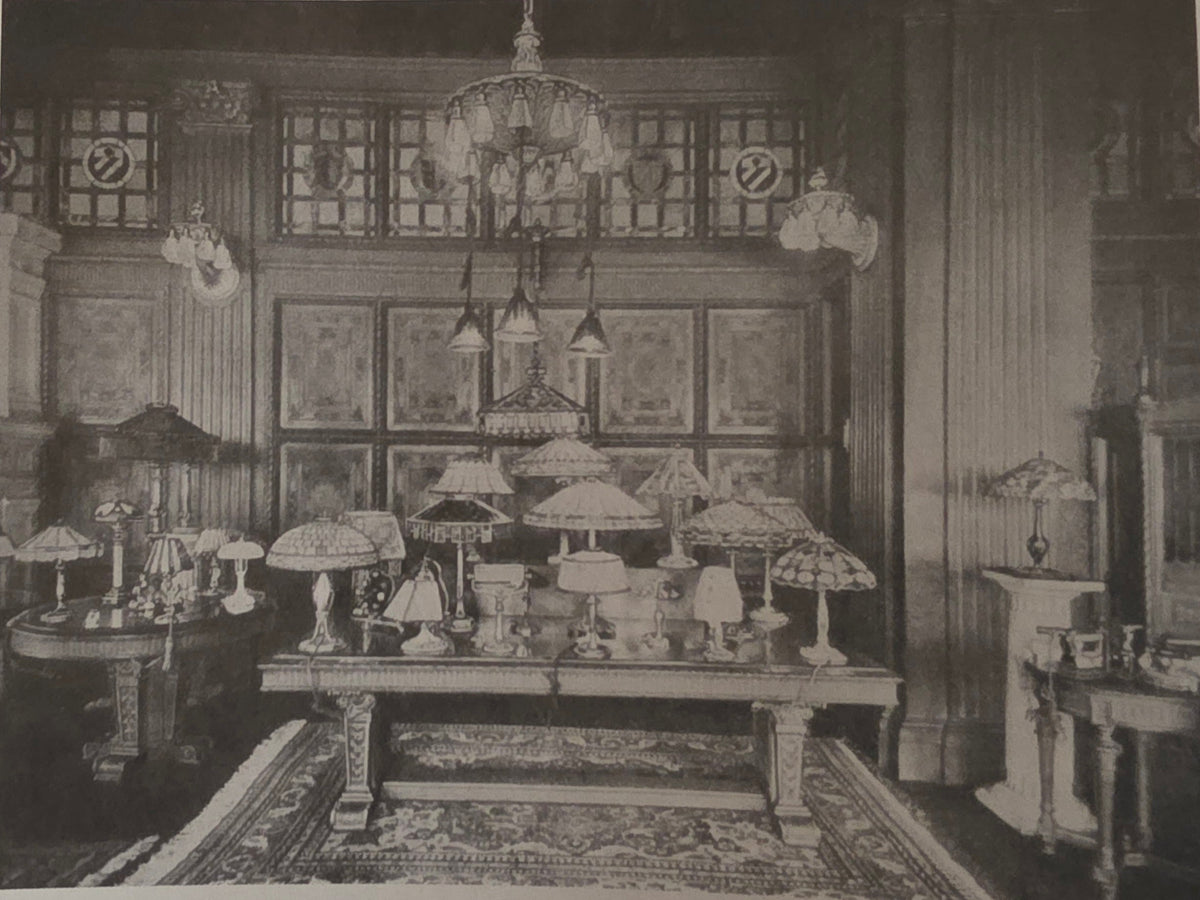
Their goal was to establish legitimacy immediately and compete directly with Tiffany's famous mosaic shades. The firm was in full-scale production by 1906, and its lamps were offered for sale through prestigious retailers including Theodore B. Starr on Fifth Avenue, Bailey, Banks & Biddle in Philadelphia, and the Chicago Electric Shop, which carried up to a hundred Duffner & Kimberly lamps at a time. While they produced magnificent, high-quality lamps that were on par with Tiffany's best work, the company was overwhelmed by financial difficulties following the Panic of 1907. A fire in their factory on 26th Street in December 1910 compounded their troubles, and the firm filed for bankruptcy on April 13, 1911. Duffner left the partnership, and Kimberly reorganized the business briefly as The Kimberly Company before being forced into bankruptcy again in 1913. Because of this incredibly brief manufacturing window, surviving Duffner & Kimberly lamps are remarkably scarce.
Signature Duffner & Kimberly Styles and Materials
Duffner & Kimberly sourced their glass from the finest commercial manufacturers available, carefully selecting pieces with complex coloring and unusual tonal qualities to achieve the effects their designs demanded.
Intricate, Densely Leaded Designs. The company employed highly intricate patterns — both geometric and floral — with exceptionally dense leading. These designs created remarkable visual richness and depth, and represent some of the most complex pattern work produced by any American leaded glass manufacturer of the period.
Distinctive Color Palettes. Rather than following the intense, saturated palette popular at the time, Duffner & Kimberly developed their own sophisticated aesthetic — concentrating on established period styles with refined, complex color combinations that gave their lamps a distinctive character immediately recognizable to collectors today.
Base Construction and Quality
Duffner & Kimberly produced an impressive array of bases using two primary materials. The quality and type of base paired with a shade is a significant factor in determining the value of a piece on today's collector market.
Cast Bronze. Their bronze bases were of exceptional quality, often featuring meticulous hand-chasing by European-trained craftsmen. Period-style bases such as their Louis base models display crisp, regular forms that are fully on par with, and in some cases surpass, Tiffany's bronze work.
White Metal (Spelter). A percentage of their portable bases were slush-cast from a high-lead zinc alloy to serve more price-conscious markets. This material allowed for smooth, flowing Art Nouveau shapes.
How to Authenticate a Duffner & Kimberly Lamp
Because many lamps left the factory unsigned, authentication requires a deep familiarity with the company's specific proprietary hardware.
The "Heart-Shaped" Cluster. Duffner & Kimberly's standard composite socket cluster was pressed from sheet brass and features distinct heart-shaped ventilation holes. It slips 3 3/8 inches and accepts a shade with a 3 7/16-inch aperture. The presence of heart-shaped cutouts in the socket hardware is one of the most reliable indicators of a genuine Duffner & Kimberly piece.
Specific Heat Caps. They utilized very specific caps to fit their standard 3 7/16-inch shade rings. The most common are a plain cast bronze dome with four heart-shaped holes, or a plain stamped copper sheet metal version punched with a fleur-de-lis pattern. Both are generally accompanied by a plain, turned teardrop finial.
The Value of Duffner & Kimberly Lighting Today
Because the company produced lamps for barely five years, their overall output was extremely limited. The market value of a Duffner & Kimberly lamp is determined by the complexity of the leaded glass pattern, the condition of the piece, and the quality of the original bronze or white metal base it is paired with. Rare, highly detailed period designs command exceptional values among private collectors.
Selling Your Duffner & Kimberly Lamp
If you own an authentic Duffner & Kimberly lamp and are considering selling, we invite you to contact us directly. We are always actively acquiring high-quality period lighting for our private collectors and would be happy to discuss the potential purchase of your piece.